Healer’s Burden
The Reincarnated Demon King's Host Just Wants to Live in Peace, But the Hero Won't Leave Him AloneHealer’s Burden names the central contradiction of Theo’s life as a healer. His extraordinary magic gives him the power to mend bodies, but that power also teaches him to treat every failure, every relapse, and every death as a personal accusation. His decisive lesson is not that healing is useless, but that a healer must recognize the limits of cure, accept dependence, and allow other people to care for him.
Origins of the Burden
Theo’s burden begins with a gift that removes choice from his childhood. After the court mage sees the deep emerald glow of his healing power, she declares that someone with such a gift belongs in the Hero’s party. Theo is taken away to study with Camden, the greatest healer available to him, and is placed in a cottage outside town rather than allowed to remain with his parents. His parents stand by disappointed that his ability will not benefit them, while Theo is left to carry the consequences of a destiny chosen by others.
Camden’s condition gives Theo an early, concrete form of healer’s guilt. The priest had served in Eliza’s party and had been badly injured in the final fight, losing mobility in both legs. Malthios tells Theo that he caused the injury by dropping a pillar on Camden, adding that healers are always targeted first. Camden is nevertheless kind and pleased to teach him, and his cottage becomes a refuge near the forest. Theo is grateful for that refuge, but every request for assistance and every mention of Camden’s former freedom makes him feel responsible for a disability he did not cause. His healing vocation therefore develops alongside a destructive belief: if he cannot remove another person’s suffering, he may be morally at fault for it.
His power makes the contradiction sharper. Because Theo can draw on the Demon King’s mana, he becomes a stronger healer than Camden within a few years, potentially surpassing what an elf might achieve over a lifetime. He deliberately restrains his ability so that others will not suspect the source of his strength. Healing is thus both his greatest skill and a secret that isolates him. Malthios helps him with book studies, while Sasin teaches him hand-to-hand combat and knife work, but neither training erases the conviction that his body and magic exist chiefly for other people’s survival.
Care, Refusal, and Chosen Family
Theo’s difficulty is not limited to curing illness; it extends to receiving ordinary care. When he collapses with a severe fever, Imani sits at his bedside, removes the cool cloth from his forehead, and checks his temperature. When Theo tries to dismiss the trouble he has caused, her sadness and anger stop him. She asks when he will let other people care for him, then leaves before he can answer.
Dale makes the same argument through practical tenderness. He props Theo against pillows, feeds him broth from a tray, and explains that he and Imani cannot have children but had instinctively felt that Theo needed them when he first came to their tavern. Their affection gives Theo experiences his birth parents never provided: Imani’s first embrace, Dale’s specially made cake for Theo’s eighteenth birthday, smiles, kind words, and dependable actions. Theo admits that his parents’ absence has made him afraid of connection, though the deeper truth is that he fears losing people if they discover the secret he carries. The healer who expects himself to protect everyone has learned to interpret being protected as a danger.
This refusal creates a painful imbalance in the community around him. Many people care for Theo, including Camden, Imani, Dale, Nib, Amaya, and Luc, but Theo keeps them at a distance because attachment would make betrayal or rejection more devastating. The burden is therefore psychological as much as professional: he can place his hands on another person’s wound, yet cannot surrender control of his own vulnerability. His relationships gradually challenge that pattern by showing that care can be reciprocal rather than a debt he must repay.
Glefald and the Limits of Cure
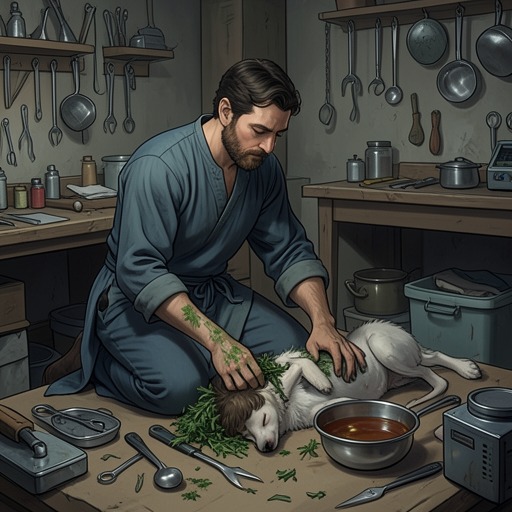
Glefald’s illness is the clearest test of Theo’s understanding of healing. The elf has suffered for years from an incurable disease created by demons that causes rot in the lungs, difficulty breathing, and occasional coughing of blood. Theo previously heals the worst of the condition and develops an infusion that can be added to boiling water, producing healing steam that slows the return of the rot. The treatment is useful but not permanent, and that distinction becomes crucial when Glefald’s disease returns.
When Theo is summoned to Glefald’s room, he finds the elf skeletal beneath a quilt, pale against the pillow, with a burner and a pot of boiling water sending steam through the air. Theo begins examining him with magic and immediately recognizes the truth: Glefald is dying, and the relapse could not have become so severe overnight. Theo is furious that Glefald concealed the deterioration, but his anger turns inward almost at once. He blames himself for avoiding visits because of Hayden, believes he should have detected the relapse earlier, and connects Glefald’s suffering to the fact that he is sheltering the being responsible for the disease.
Glefald refuses to let Theo define the moment as a medical failure. He closes his thin fingers around Theo’s wrist and tells him that he is ready, describing death as the end of a chapter. The statement places consent and acceptance beside treatment: Glefald is not merely a body awaiting repair, but a person able to understand his prognosis and choose how to meet it. Theo responds through his pendant, a vine-covered antler gifted by Camden as the symbol of Arriss, the deity of healing, balance, and death. He says that he does not believe in deities, asking why any benevolent power would allow horrible things to happen to innocent people.
Glefald answers by shifting the source of faith away from guaranteed rescue. He suggests that faith may rest in fate, deities, another beloved person, or, if none of those can be trusted, in oneself. He sees Theo as a survivor but hopes that Theo will learn to let himself live. The exchange reframes the healer’s task: preservation matters, but so do witness, dignity, and the patient’s ability to face an ending that magic cannot cancel.
The Healer in Community and Conflict
Theo’s response to other people’s weakness is often severe because he measures them against the standards he imposes on himself. When he assesses the Hero’s party, he identifies a pattern of overwork, inadequate sleep, poor nutrition, and neglected injuries. He warns that Luc relies on physical magic and needs proper food or he will be weakened and at risk of killing himself against a difficult foe. He also identifies Avery’s untreated weak lungs, Veiv’s inflamed hand joints, Bryony’s improperly healed old leg injury, and Emi’s severe muscular tension in the back and shoulders.
Theo calls it his job as the party healer to fix them and keep them in top condition, then orders the group to wash, forage, and hunt for a balanced dinner. His command shows the breadth of his conception of healing. It is not only spellwork applied after violence; it includes sleep, food, prevention, rehabilitation, and the discipline to stop before the body breaks. Yet the scene also exposes the danger of his role. Theo understands how to impose healthy limits on a party, but has difficulty applying the same limits to himself.
The same tension appears in his relationship with Camden. When Theo is brought to Luc’s bedroom and sees Camden in his wheeled chair, the old healer’s softened smile and more deeply lined face still shock him, even though Theo has known his condition for years. Camden represents both the mentor who made Theo’s vocation possible and the living reminder that healing cannot restore every lost capacity. Theo’s response to Camden is gratitude braided with guilt, a pattern that recurs whenever he encounters a body that magic cannot return to an earlier state.
Recognition, Change, and Continuing Work
Glefald’s decline finally forces Theo to confront the lie that a healer’s worth can be measured by the number of people he saves. After leaving Glefald, Theo returns to Leafel in a state of emotional collapse. Luc sees that something is wrong, checks Theo for injuries, and receives him when Theo drops his basket and embraces him. Theo cries while reporting that Glefald is dying and that his healing could not save him.
Luc directly rejects the accusation Theo has placed on himself. He tells Theo that it is not his fault, that even Theo cannot save everyone and is not a god, and that death will come for all of them. Theo’s tears matter because they occur around Luc, where he has begun to feel safe enough to express emotions. Luc wipes the tears from his face and observes that Theo’s walls are cracking. The image captures a change more important than a new spell: Theo’s healing begins to include the admission of need.
That change remains incomplete rather than magically solved. Theo still carries responsibility for others, still monitors bodies and risks, and still works intensely. In the autumn epilogue, he is writing labels at his shop while Luc distracts him, and Theo responds by striking him with an elbow before telling him to behave because there is much work to do. He is also harvesting the garden and foraging in the forest for ingredients to last through winter. The scene preserves his vocation as labor, but it places that labor within a network of assistance: Micah is training with Wicker, Raf and Liffey lend Dmitri for the harvest, and Luc helps with gardening despite lacking patience for it.
Healer’s Burden therefore ends not with Theo abandoning care, but with care becoming less solitary. He remains responsible for treatment, preparation, and the wellbeing of the people around him, yet the surrounding community increasingly shares the physical and emotional work. The concept’s lasting significance lies in that tension. Theo’s power can slow Glefald’s lung rot, diagnose hidden injuries, feed a feverish body, and protect a party from its own neglect; it cannot abolish mortality or substitute for trust. His real development begins when he understands that accepting care is not a failure of the healer’s duty, but part of surviving it.